
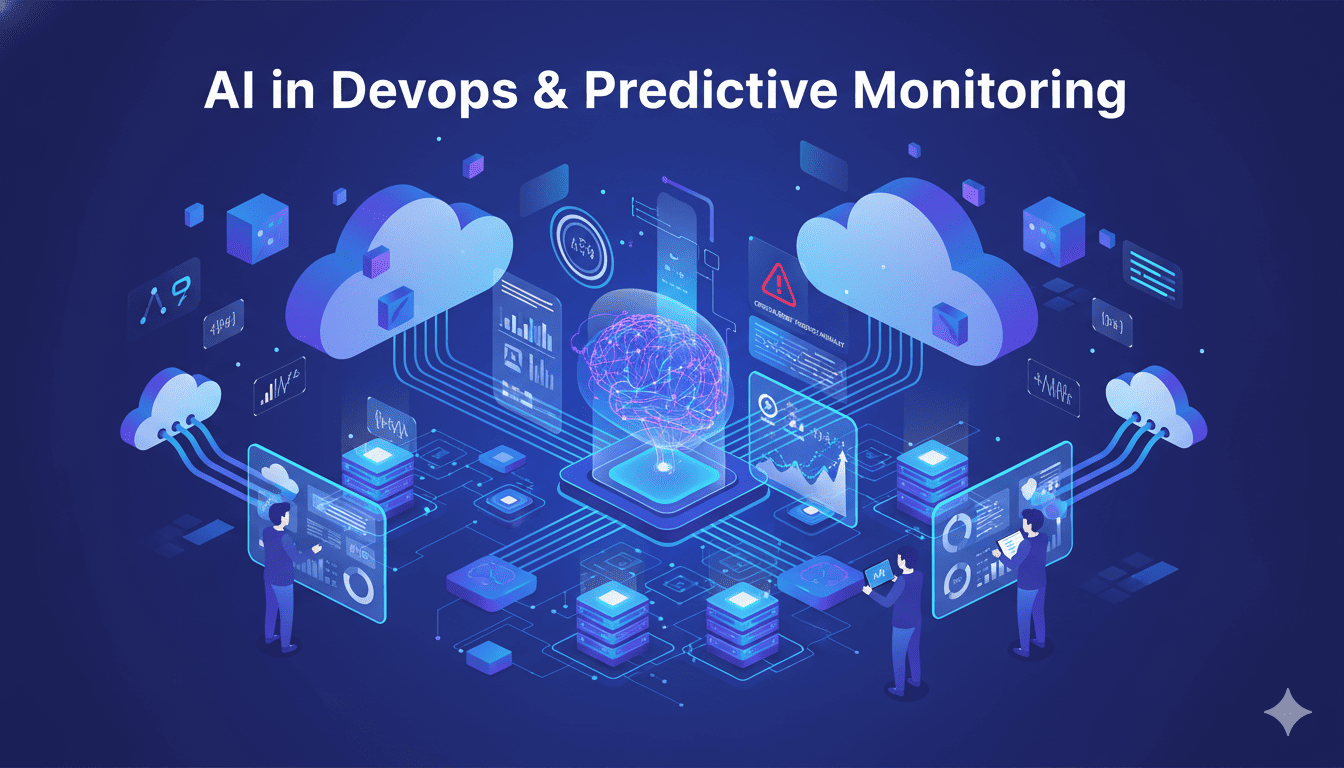
Modern software teams move fast. They update them weekly, even daily. However, uncontrolled speed is dangerous, and servers fail. Applications slow down. Minor problems become massive outages. That is where the impact of AI in DevOps comes to the world.
AI and machine learning make teams more predictive than prescriptive. It reduces downtime. It improves system performance. Most importantly, it provides businesses with stability as they grow. At Newton Byte, we assist the growth of companies across the Globel in building strong DevOps systems leveraging smart monitoring and automation. Let’s understand how this works in simple words.
What Is DevOps in Simple Terms?
DevOps is a combination of “Development” (Dev) and “Operations” (Ops). It’s a set of practices that helps software teams work together more efficiently to build, test, and release software faster and more reliably.
Think of it like this:
- Traditionally, developers write code and throw it “over the wall” to operations teams, who manage servers and deployment. This often causes delays, miscommunication, and bugs.
- DevOps breaks down that wall. Developers and operations teams collaborate throughout the entire software lifecycle, from writing code to deploying it and maintaining it in production.
However, as systems grow, managing everything manually becomes difficult. Logs increase. Alerts multiply. Infrastructure becomes complex. Human teams alone cannot monitor everything in real time. This is why AI-powered DevOps is becoming essential.
What Is Predictive Monitoring?
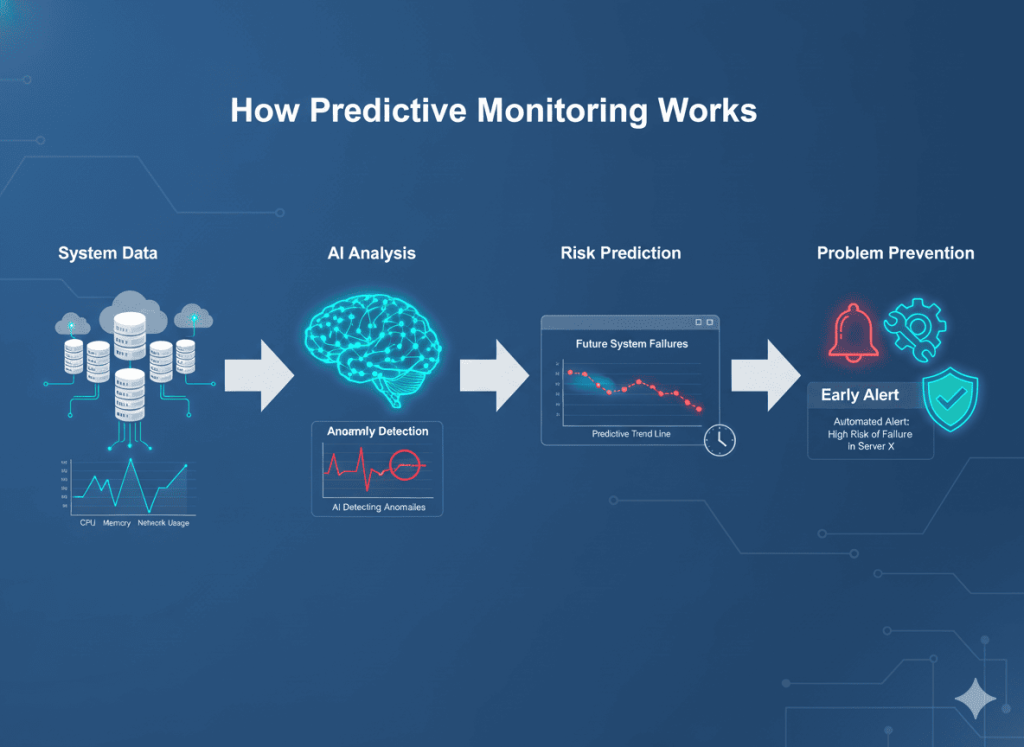
Traditional monitoring waits for something to break. For example, if a server crashes, the system sends an alert. Predictive monitoring works differently. Instead of reacting after failure, AI studies patterns in data. It learns how your system behaves. When something unusual starts happening, it warns you early.
For example:
- CPU usage slowly increases every evening
- Database response time slightly drops each week
- Memory leaks grow silently over days
These small signals are easy to ignore manually. AI sees them clearly. As a result, businesses fix issues before customers even notice them.
Why Traditional Monitoring Is Not Enough
Let’s be honest. Most companies use basic monitoring tools. They show dashboards and send alerts. But they have limits:
- Too many false alerts
- No understanding of patterns
- No learning from past incidents
- No prediction of future failures
When hundreds of alerts appear daily, teams feel overwhelmed. Important warnings get ignored.
AI solves this problem by filtering noise and highlighting real risks.
How AI Improves DevOps
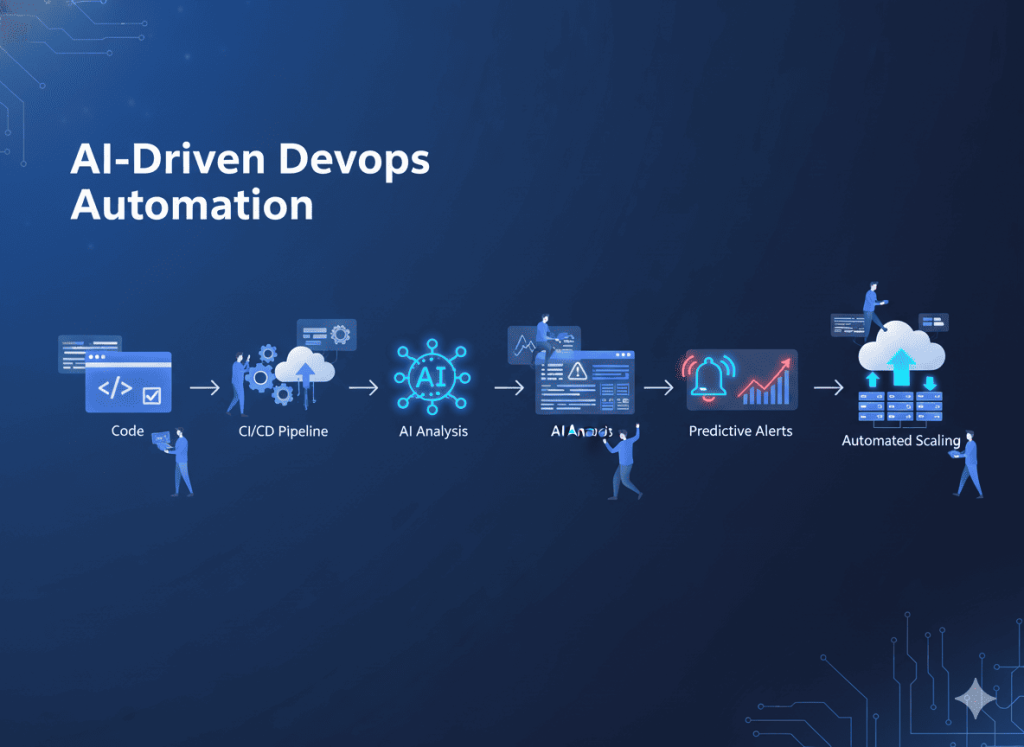
AI supports DevOps in several powerful ways. Instead of replacing teams, it strengthens them.
1. Smarter Log Analysis
Applications generate massive logs every second. Humans cannot manually read millions of lines. AI can:
- Scan logs instantly
- Detect abnormal behavior
- Identify hidden error patterns
- Group similar incidents together
This saves hours of manual investigation.
2. Intelligent Alert Management
Not every alert is urgent. Some are minor. Some repeat unnecessarily. AI systems:
- Reduce duplicate alerts
- Prioritize critical issues
- Send alerts only when action is required
This keeps teams focused and calm.
3. Automated Root Cause Detection
When a system fails, finding the root cause takes time. It could be:
- A recent deployment
- A configuration change
- A database slowdown
- A network issue
AI compares historical data and quickly suggests the most likely cause. As a result, resolution becomes much faster.
4. Predictive Scaling
Traffic changes during sales, campaigns, or seasonal events. AI analyzes past patterns and predicts future load. Therefore, it can:
- Automatically scale servers up
- Reduce resources when traffic drops
- Prevent overload during peak times
This reduces costs and improves performance at the same time.
AI in Continuous Integration and Deployment (CI/CD)
DevOps includes CI/CD pipelines. These pipelines automatically test and deploy new code. However, deployments sometimes break systems. AI improves CI/CD by:
- Predicting risky code changes
- Analyzing past deployment failures
- Automatically stopping unstable releases
- Recommending safe rollback points
Because of this, businesses reduce failed releases and protect user experience.
Real Example: Predictive Monitoring in Action
Imagine an e-commerce platform in the Middle East. During Ramadan sales, traffic increases sharply every night.
Without AI:
- Servers crash at peak hours
- Customers face slow checkout
- Revenue drops
With predictive monitoring:
- AI studies last year’s Ramadan traffic
- It predicts this year’s surge
- Servers scale automatically before traffic peaks
- Checkout remains fast
This is not a theory. This is practical AI-driven DevOps automation.
Key Benefits of AI in DevOps
When implemented correctly, AI delivers measurable results.
Better Stability
Systems crash less. Issues get fixed earlier. Performance stays consistent.
Faster Incident Response
AI reduces investigation time. Teams fix problems in minutes instead of hours.
Lower Operational Costs
Smart scaling avoids over-provisioning. Companies pay only for what they need.
Improved Customer Experience
Users enjoy fast, reliable applications. Trust increases naturally.
Challenges Businesses Face
Despite its benefits, AI in DevOps requires proper setup. Some common challenges include:
- Poor data quality
- Disconnected monitoring tools
- Lack of skilled implementation
- Overcomplicated systems
AI works best when the foundation is strong. Clean logs, structured data, and stable infrastructure are essential. That is why expert guidance matters.
How Newton Byte Implements AI in DevOps
At Newton Byte, we take a practical and structured approach. First, we audit your current DevOps workflow. We identify monitoring gaps and performance issues. Then, we implement:
- AI-powered monitoring tools
- Smart alert systems
- Predictive performance models
- Automated scaling policies
However, we keep things simple. We do not overload systems with unnecessary complexity. Our focus is stability, speed, and long-term scalability. Across the Middle East, businesses trust Newton Byte for reliable DevOps consulting services and AI-driven automation strategies.
AI and Cloud Infrastructure
Most modern businesses use cloud platforms. Cloud environments generate huge volumes of performance data. AI uses this data to:
- Predict server failures
- Detect security anomalies
- Optimize cloud resource usage
- Improve application uptime
For example, if unusual login patterns appear, AI can flag potential security threats instantly. This adds an extra layer of protection.
The Role of Machine Learning
Machine learning is a part of AI. It helps systems learn from historical data. Over time, machine learning models:
- Understand normal system behavior
- Detect small deviations
- Improve prediction accuracy
- Reduce false positives
The more data the system processes, the smarter it becomes. This continuous learning makes predictive monitoring powerful.
AI in Security Monitoring
Cyber threats are increasing globally. DevOps teams must also protect applications. AI enhances security by:
- Detecting abnormal traffic
- Identifying suspicious login attempts
- Recognizing unusual data transfers
- Blocking potential attacks automatically
Instead of waiting for a breach, AI reduces risk proactively.
Why Businesses in the Middle East Need AI-Driven DevOps
The region’s digital market is growing rapidly. Startups, enterprises, fintech platforms, and e-commerce brands are expanding fast. With growth comes complexity. Manual monitoring cannot handle large-scale systems. Businesses that delay AI adoption often face the following:
- Repeated downtime
- Slow deployments
- Increased infrastructure costs
- Customer dissatisfaction
On the other hand, companies investing in predictive monitoring solutions gain a competitive advantage. They operate smoothly. It scale confidently. They innovate faster.
The Future of DevOps Is Intelligent
DevOps started as a collaboration between teams. Today, it is evolving into intelligent automation.
In the future:
- AI will predict code vulnerabilities before deployment
- Systems will auto-heal without human intervention
- Performance tuning will happen automatically
- Monitoring dashboards will become decision engines
Businesses that adopt this shift early will stay ahead.
Conclusion
Progressing with AI in DevOps is no mere fleeting trend. It really solves problems. It lowers operation downtime; it promises better deployment quality. In general, this reduces operator stress and preserves the quality of the customer experience. Predictive monitoring totally changes the way teams work. Instead of responding to faults, they avoid them at the source.
Middle Eastern businesses can use AI-powered DevOps strategies to build secure systems that are large, stable, and wonderfully robust. When your entire setup is driven by response rather than initiative, it’s time to make a change. The system keeps the company running.
FAQs
AI in DevOps has evolved by incorporating artificial intelligence into monitoring, automation, and deployment processes. It analyzes system data, predicts failures, reduces false alerts, and helps teams respond faster to technical issues.
Through predictive monitoring of historical system behavior, early warning signs of unusual patterns can be detected. It stops being a question of waiting for the crash: it’s far more important to warn others, if you will pardon the expression. Restraining damage and reducing downtime.
Of course. Thanks to AI-driven monitoring, even small enterprises can save on a lot of manpower needed for very little return. It also prevents breakdowns and cuts infrastructure costs. Furthermore, as the business’s scale grows or if dynamics change within their operational practices, so too does this kind of system. It is possible to create an entirely suitable monitoring network for each business.
No, AI is the work of a supporter; it does the repetitive things that are needed. It discovers hidden rules and improves prospects greatly. In the end, however, human wisdom is essential for decision-making and system planning.
The Middle East’s Newton Byte specializes in predicting, monitoring, business optimization, and high-value consulting for businesses using big AI. An AI-based system of automation is at your fingertips with Newton Byte, on a system mail that will be built and trained just for your needs.